

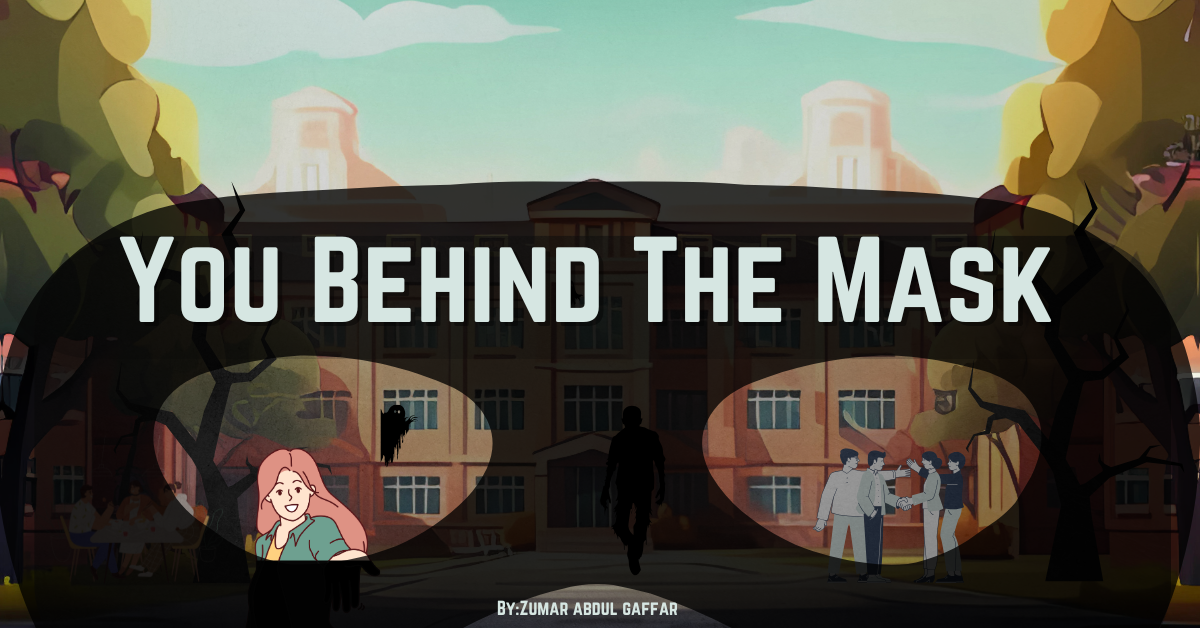
After having a mechanical breakfast, you step into the grounds of what most consider the epitome of education–a socially interconnected abode of learning, as known as your college. With every step towards your class, the impassive onlooker waving at you becomes clearer in your peripheral perspective. A sigh stuck in your throat oozes to get out as you gulp the trembles in and wave back with an enthusiastic “hey, wassup!”
Soon, more faceless creatures join in, conversing about topics irrelevant to your current state of mind. Perhaps the ones in front aren’t faceless–it’s you, unable to grasp their expressions, either because you don’t want to, or you’re conserving your energy for something far more important yet uncertain.
At the front, the engagement is abundant, yet you still feel the connecting threads skimming right past you, never quite touching you. You feel like a third person overlooking the picture rather than the first person within it. Every ‘hi’ and ‘bye’ marks the ‘not fitting’ scar in your inexplicably carved mind.
Moving past them, more people wave hi, but you can’t recall their names or if you’re even friends. You wonder why you feel so irrelevant amidst all the social interaction as even when conversations shift to topics you enjoy, a heavy weight presses down on you causing your words to stifle. You sit back as a listener, a quiet observer, swallowing your thoughts to give others room to speak, afraid to overstep and seize chances from others.
Then there are those friends you genuinely like–who you share moments of laughter and interests with, yet even in those interactions, you find yourself mirroring their habits, as if adopting their personas might help you feel more connected. While with others, you feel compelled to hang out out of pity or obligation, finding the exchanges awkward and draining, your heart heavy with the knowledge that you’re not truly present.
Everyone perceives you as social, helpful, and extroverted, yet inside, you wrestle with unspeakable silencing violence. You strive to express yourself but end up restraining your true feelings, trying to keep others in mind. And when you do withdraw into silence, you feel that familiar ache of disconnection returning, wanting to be alone as solitude might be your only solace at this point. Your friends make plans, and you want to decline, but the thought of missing out gnaws at you. You feel compelled to join, not for the excitement but to avoid the weirdness of being left out, watching from the sidelines while they post joyful updates on Instagram. Yet, when you do go out, a nagging sense of guilt washes over you for not wanting to be there in the first place. Your radio-head echoing that You’d have felt better if you stayed at home to serve as a reminder of your betrayal to yourself. The dichotomy is exhausting.
Every message that pings your phone feels like an obligation to respond. The guilt of ignoring friends eats away at you, urging you to reply, even when you dread the conversation. You find yourself trapped in a cycle of social expectations–the narratives we’re told about being social animals ingrained in you since childhood. Every job posting and university application emphasizes the need for social skills and popularity, heightening your sense of inadequacy. You begin to feel inhumane, like a robot programmed to act a part but unable to connect with normal human emotions.
Why don’t you feel the same joy as others when they receive gifts or share good news? Why does happiness seem to slip through your fingers? You question whether it’s you or the world around you that’s broken, spiralling into guilt and confusion as you ponder the disconnect between your internal landscape and the vibrant lives of those around you. In this whirlwind of interactions, you’re left grappling with an unsettling thought: Is it possible to truly connect with others while feeling so profoundly disconnected? As the faces blur into a chaotic tapestry of social expectations, you wonder–do they feel the same alienation? What does it mean to be social in a world where connection feels so superficial? And ultimately, is this the price of belonging in a space where everyone is expected to fit in, yet no one truly does?
Perhaps in the constant ebb and flow of social interaction, the feeling of not quite fitting in is less an anomaly and more a quiet, unspoken truth we all carry in different ways. Maybe the faces that seem so connected are, in fact, masked like your face, grappling with their own inner voids–just as distant, just as unsure. Perhaps belonging isn’t about constant engagement or feeling joy every moment but acknowledging the ebb and flow of human connection, realizing it’s okay to feel out of sync.
In the end, maybe it’s not about fitting into the social puzzle or masking alienation, but about embracing the quiet moments in between–the ones where you can reflect, recharge, and simply exist without the pressure to be anything other than yourself. True connection, then, might lie in accepting that disconnection is part of the human experience, that we are all navigating it, whether we admit it or not. And in that realization, maybe–just maybe–we’re not as alone as we think.
Zumar Abdul Ghaffar
Team Writer (2025-2026)
