

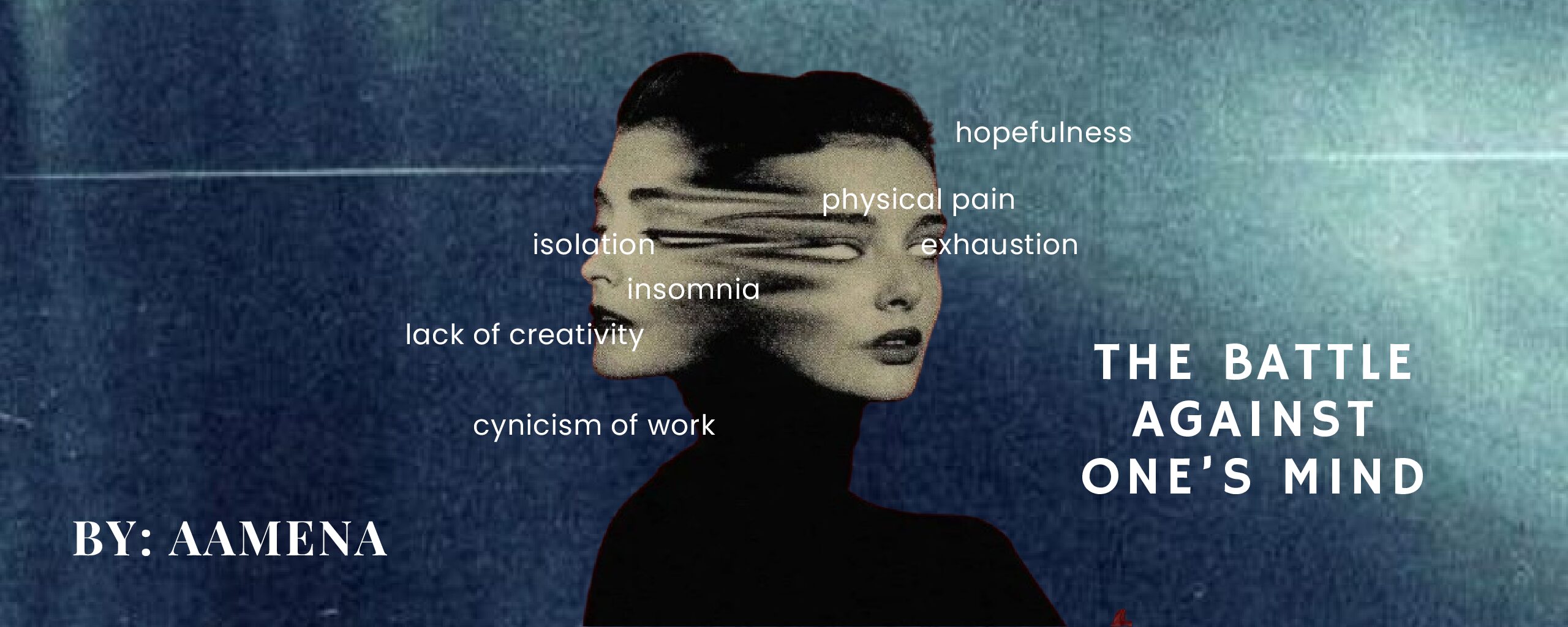
As you pick up your phone for the hundredth time that day, you wonder what the reason for your unproductivity is. The lack of ideas, or your lack of trust in your own creativity? You scroll through your Instagram reels, filled with all the things you wish to be; everything but yourself, and a bitter taste fills your mouth. You glare down at your empty page, in the mirror; both reminders of what you’re so abysmally lacking. But is it truly you who is flawed, or your mindset? Why is it that no matter how many times you push yourself up to grab your pen, the only thing running around your mind like a mantra is your own sense of inadequacy?
Everything you do seems to be a feeble attempt at belonging to a system you never quite understood—falling behind on deadlines, being constantly reprimanded because “you don’t write the way you used to”, when you can’t even find yourself in the tangle of emotions inside your head—crumbling into rubble the fragile facade of inclusion you built. You feel like a fraud, an imposter. And bit by bit, your motivation, your bright, unique ideas fade to dust, until all you can do is stare at the reels on your phone and carry your pathetic, envious heart. Days pass like this, accumulating into months until the due date for the commonwealth essay is long gone, until you realise you haven’t touched your university application in so long you don’t remember where you left off. Your mind manipulates you to believe that all the events up till now were meaningless and you have no one to blame but yourself.
In class, you get chided repeatedly for missed assignments and your weak interjections go unheard. Your walk home is slow. Heart heavy and burdened with unsaid thoughts that weigh cruelly like bricks. You see your reflection in the window of a book store and you can barely recognise yourself. You peer through, eyes landing on a girl, aimlessly tracing along the spines, and your mind seems to hyperfocus. You see yourself standing there, trying to orient yourself, as if begging the books themselves to yell out the solution you’ve been searching for. That is when you realise that amongst all the self-doubt and depression, you lost your sense of purpose. Writing became a chore, rather than a desire to create. Your eyes start to find more of you within the store, writers just as lost, and there is a shift in your perspective. The world doesn’t seem all that lonely anymore. On a plane on which you thought you were solitary, you are now surrounded. For the first time in a while, something snaps in your mind: before you know it, you’re stepping into the bookstore, ready to reignite your flame of passion. Hours pass once you let your pen touch paper as the words flow, the invisible barrage shattered. You know it won’t last forever, but this high is exhilarating and you try to salvage the little ember as much as you can, before it goes out again, before you have to wait another few months to feel hope again.
Creative block affects many people around the globe. Due to many factors, psychological and external, it is a mindset that is not an easy one to escape. Be it burnout, selfdoubt, or obsession with perfectionism, everyone has experienced it. When you’re so deep in your head, how do you recuperate and surmount the mountain of neverending expectation? It all starts with your purpose: Why do you write? To heal your inner child? To burn even a little bit of the darkness away? To ease the pain of the burden of thoughts weighing in your heart? Or simply, for your own pleasure? Whatever it may be, each creation has a purpose, and you must remember yours to keep the flame of motivation ignited. When your mind does go blank, let it wander because caging it up with self-deprecating thoughts will only dig that hole deeper. Give yourself time, and before you know it, your mind will click, and your pen will flow freely. There isn’t a straightforward way to overcome writer’s block, but a consistent and hopeful search for inspiration can go a long way.
Even the greatest authors have had to pause—have had to reassess, have had to doubt themselves to grow further, to overcome their prior strengths, to achieve new heights. There is no such thing as a perfect writer, only one who perseveres and learns to cherish their work, and treats every failure like a lesson in and of itself. So, instead of dropping the whole glass because a few drops escape, remember that patience is virtue, and keep holding your pen, for losing it will be admitting defeat. And holding on will mean you still possess the strength to create.
Aameenah Kazmi
Team Writer (2025-2026)
