

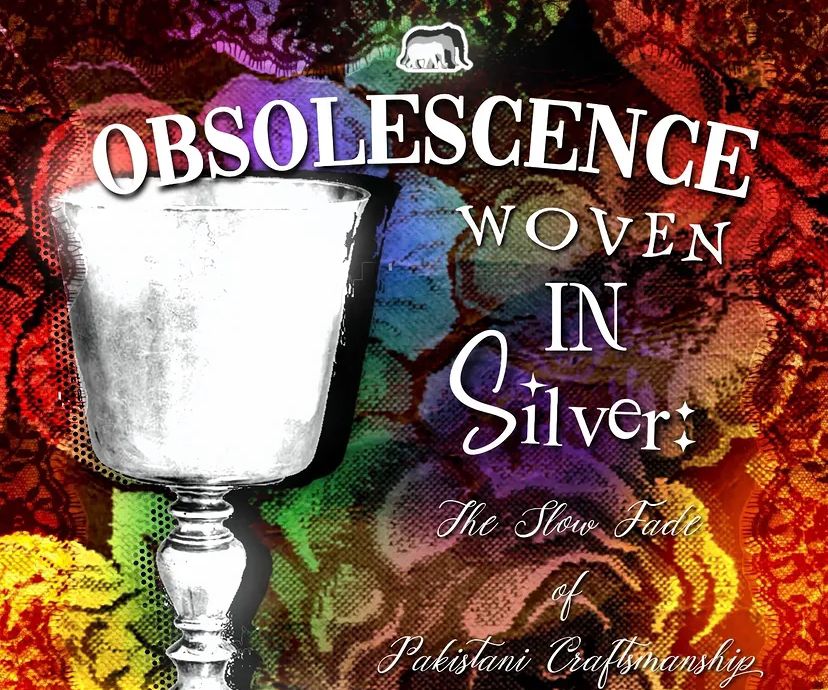
Moons in metalworks.
Puppets in makeshift cinemas.
Threaded tapestries on wooden floors.
The grandeur of calligraphy.
Our modern world progresses more and more each day, and we find our centuries old traditional Pakistani craftsmanship transforming into a testament of the past.
Where the craftsman sits on the street, the metal laden at his feet, the world loses itself in the digital universe. Once, decades ago, his shop bristled with gatherings and purchasers, who embraced the metalworks; now he has no mentee. There were the puppets that danced in the amaranthine bliss of colours flowing through the curtains, and crowds that were awed with fascination. Those streets now howl in emptiness, with those puppets sitting discarded in the farthest corner. The puppet’s strings lay on the ground in an empty box up on a shelf. The hammer stays there idle, in the abandoned, dulled metalwork craft shop.
But what were these crafts, truly? Beyond the metals and threads, they were a veil, a vessel—of memories, of love passed down from one hand to the other. It is undoubtedly known that the richness and embodiment of these cultural crafts, honed by skilled craftsmen, were more than just a job. Descendants upon descendants, working on creating cultural masterpieces, teaching their children and youth deeply adoptive cultural practices, art, and craftsmanship. Ringing out papers and marvelling at paints and ink on sheets to create the moving calligraphy, aimed at a more culturally enigmatic spiritual exploration. Their central purpose was to offer a semblance of ritualistic identity and communal pride in producing art in a more culturally responsive form. To engrave not just a message of spirituality, but to etch into the metals and clothes a message, one of an inherently rich sense of belonging: To be an elegy of Pakistani heritage.
And yet, as time surged forward, that spiritual and cultural resonance began to wane. In our modern day, we find ourselves suspended in the digital world and its industrial tides. Slowly shifting from a sense of fulfilment to efficiency in the production of mass-produced crafts, all dependent on the flow of algorithmic trends that shape the horizons of the digital world. Our grand, flamboyant, and dignified crafts, once our identity and heritage, now hide behind screens. Discarded away in online storage files in mere forms of trendy images and idolization of art, with no real sense of ownership over heritage. Most of it was transformed into a catch game for the industrialization of their purpose. The truest artisanal dignity shifted into a mere consolation for decor and art, not seeing behind the ink that sits on it, the hands that carved it into life, the brushes that swayed over it. The lamenting talent, all but, smoked away because our world loses the importance of understanding the purposefulness of cultural heritage.
Beyond the loss of the aesthetic values lies something more personal—more aching.
Years ago, in the Pakistani craftsmanship industry, one of the most remarkable relationships that flourished in building the heritability in the crafts was a deeply bonded relationship of an ustaad, the mentor craftsman, and his shaagird, the student. The expert would pick up the hammer and mold the metal into another piece; his shaagird would learn from him. With the ustaad offering mentorship, and the shaagirds eager to learn, they formed the artworks into much more than just something one’s eye would appreciate; it would be what the heart could feel. However, in our modern world, today, our youths have fewer means of learning and social stigmas, which are paired with low income that prevents a rooting interest in such craftsmanship. The masters sit in their empty shops, longing for their shaagirds as they experience a progressive generational loss of heartfelt art and companionship.
They sit not just in physical silence, but in the growing silence of memories. Despite this tidal shift in our industry, we still find ourselves immersed in the feel of those lost olden times. Wondering if this loss of artisanship is worth the progression of our diluted industrial ascension? The question sits, when we walk by empty shops, solemn craftsmen with unpurchased crafts hanging, when we see the weavers making carpets that sit forever rolled up in the corner of the shops, when we witness the tangas (horse carts), barren and discarded on roads. The answer slips with the realization that the very hands that built our visual and cultural heritage are regressing. And with this characteristically inherent fire for art, some still work for the preservation of our delicately serene cultural crafts.
Therefore, with the slow fade of our cultural crafts, preservation efforts are ongoing—with Lok Melas and heritage festivals, the culture revives again, slowly but surely. People join in on working on keeping the traditional art alive: with students offering insights to curious tourists, and media housing the spotlight of dying crafts in segments, NGOs partner with craftsmen to offer visibility. In Lahore, Pakistan National Council of the Arts hold their crafts in fairs, in Sindh, Truck art and Ajrak weaving shops continue small but still, rather passionate crowds. Not only that, but with the help of social media romanticising old crafts—renewed markets can be found with craftsmen hard at work. The ember still glows in the roaring fire, reminding that not all is lost. Perhaps what we require is actually not just the revival for the sake of nostalgia, but by re-planting: placing these crafts within our identity, restructuring education, and reimagining the industry to include them not as outdated forms, but as heritage itself. The ustaads still sit their crafts decoratively on shelves, awaiting their new shaagirds.
Hajra Ahmed
Team Writer (2024-2025)
