

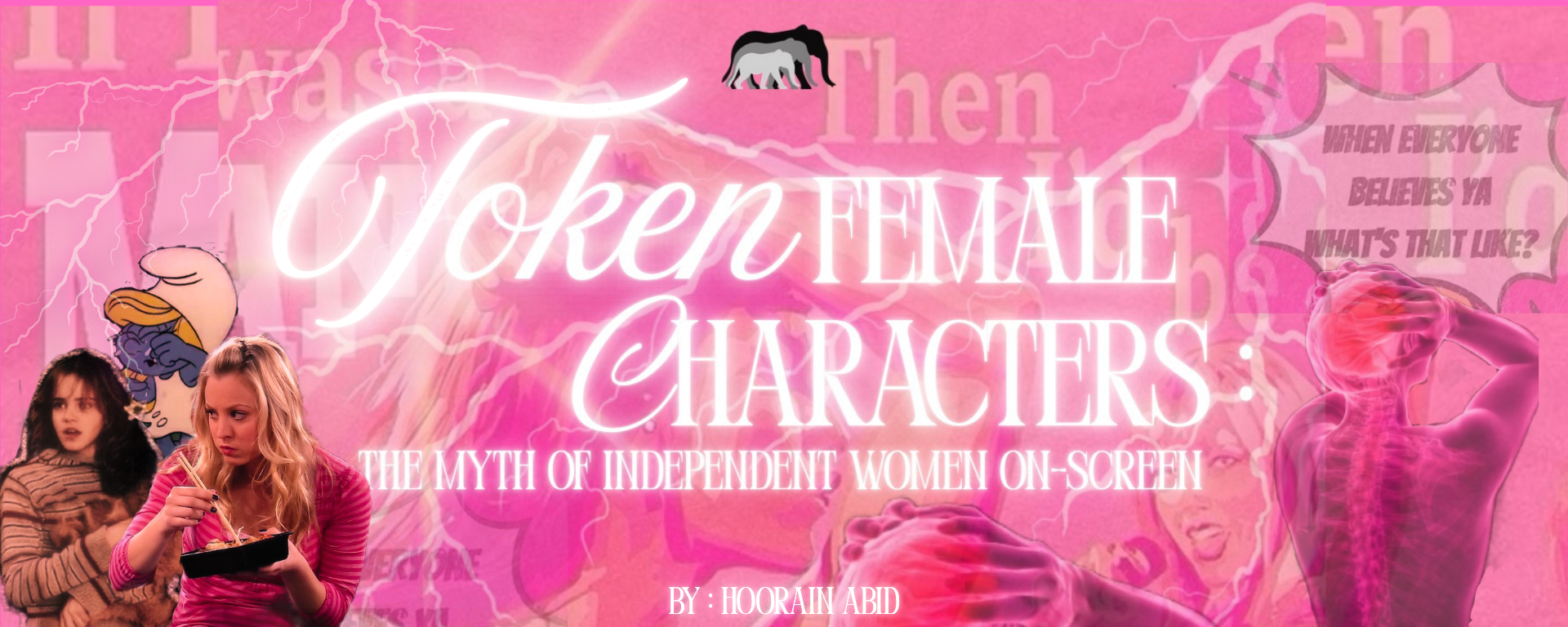
The characters we grew up loving and the ones presented on our screens today are not so different after all–they often embody the same arc recycled in ten different fonts. From children’s movies or prime time adult shows, a recurring narrative structure emerges that isolates female characters in a bubble of traditional tropes and patriarchal expectations, because at the end of the day, every screenwriter seems convinced of one universal truth: the purpose of every woman’s life is either to transform herself physically, or serve as an emotional cushion for her male counterparts.
This pattern is clearly visible in the classic animated film, The Smurfs. Smurfette stands as the sole female character in a village of male Smurfs, each of whom are defined by a specific trait– such as Brainy, Clumsy, Grouchy, or Chef. In the opening arc of “The Smurfette” series, the antagonist Gargamel creates her out of dark magic, giving her stringy dark hair, representing deceit and trouble. When Papa Smurf “saves” her, his magic performs a visual makeover, giving her flowering blond hair, high heels and a stylish dress that accentuates her figure, altering her features to fit eurocentric beauty ideals. To a younger audience, this visually reinforces a problematic dichotomy; dark features equal bad while blond features equal good and pure. Ultimately, this teaches young audiences that acceptance requires a physical modification, just as Smurfette’s entry in the village is not sealed by an internal moral shift, but by an external makeover.
Smurfette’s magical physical transformation is a common fairy-tale norm observed across children’s animation, such as Cinderella’s makeover before the grand ball at the palace. These scenes convey a questionable message to young girls: that their value or belonging is tied to male approval and conforming to traditional expectations of femininity. Smurfette does not transform herself; she is acted upon by a man’s magic that alters her to fit into a male dominated world. This teaches viewers a subtle lesson about female passivity–that female identity is shaped by male authority figures, rather than being self-determined. These instances of visual storytelling conditions young women to prioritise visual appeal and to frame their worth around physicality, whilst completely ignoring their competence and character.
These archetypes exist not only in children’s media, but are prevalent across adult media as well. A primary example of this is The Big Bang Theory, in which Penny is the sole female character whose only function is to validate her male counterparts, who treat her as a “prize to be won”. Penny’s characterization relies heavily on her being physically attractive and a good for nothing “girl next door”, making her the perfect victim to the “dumb blond” punchline. Throughout the sitcom, we see how screenwriters use comedy and sarcasm to excuse objectification whilst continuously undermining her character for comedic relief. Rather than being critically analysed for being street-smart or ambitious, she is reduced to a physical object that exists to satisfy male ego. Sitcoms of this nature normalize male condescension towards women as means for a “good laugh”, subjecting them to accept casual sexism for the entertainment of men. This leads to internalized self objectification, which in turn causes the development of self-deprecating humour in teenagers. Profound self-doubt manifests as the reduction of mental health issues, such as body dysmorphia, to jokes about not being “thin enough” or “pretty enough”, masking deep rooted insecurities.
Modern Media often claims progress by giving female characters high intelligence or combat skills rather than framing their entire character on looks, yet patriarchal structures remain intact. A primary example of this is observed in everyone’s favourite blockbuster modern fantasy, Harry Potter. Within the central heroic trio, Hermione Granger is established as the most intelligent and academically gifted character, consistently providing crucial knowledge necessary for the group’s survival. However, despite her exceptional intellect, Harmione’s narrative trajectory is linked to Harry’s destiny as “the Chosen One”, as her character’s vast intelligence is primarily weaponised as a utility to solve Harry’s problems and cushion the burden of his quest rather than pursuing self-directed ambition. While Ron provides comic relief and Harry embodies the natural-born leader, Harmione is burdened with maternal caretaking and provides emotional support to her male peers. By naturalising this dynamic, the writers subtly imply that no matter how remarkable and academically gifted a woman is, her ultimate function remains tied to nurturing and validating male ambition.
Consequently, such screenplay narratives reveal deep-seated biases in media production. By repeatedly presenting brilliant women as mere facilitators of male success, while continuously failing to give female characters a central character arc driven by their own desires and personal choices, independent of the male lead’s quest. Viewers absorb the subtle message: “ A woman can be as brilliant as she wants, as long as she does not interrupt the male lead’s heroic narrative”. This cultural revelation is embedded into a woman’s consciousness, conditioning her to internalise the role of being exceptionally skilled but only in a supporting capacity.
Media tropes extend beyond fiction into the real-world, showcasing how screenwriting acts as a mirror for viewers. An example of such a narrative is seen in the rock bandFleetwood Mac. Despite Stevie Nicks and Christine McVie being the main songwriters and creative powerhouses behind many of the band’s hits (Dreams, Don’t Stop) in the 1970s, media critics frequently distilled them to their romantic relationships with male bandmates, or took it upon themselves to comment on their appearance and personal lives.
This contrast between fictional media tropes and real-world examples reveals that these screenwriting patterns are not mere coincidences; they are a reflection of embedded societal biases. Upon closer examination of how screenwriters construct female characters through restrictive archetypes–such as the emotionally driven counterpart or a love interest–we see a direct relation in visual media representation and societal expectations. Media consumers have internalized such character frameworks, which in turn minimizes real world women’s professional achievements, framing their success through personal relationships and appearances.
Hoorain Abid
Team Writer (2026-2027)
